
Blog
How to Get a USA Driver’s License in Any State

How to Get a USA Driver’s License in Any State: Complete 2026 Guide
How to get a USA driver’s license. If you need help understanding the legal process for obtaining a U.S. driver’s license, our team can provide general document and application guidance. Email: contact@officialdocssupport.com | WhatsApp: +1(672)2050601. A U.S. driver’s license is issued by the state where you apply, and requirements can differ depending on the state, your age, immigration status, driving experience, and the type of license you need.
Introduction: How to Get a USA Driver’s License
A driver’s license is an important form of identification and authorization to operate a motor vehicle in the United States. However, there is no single nationwide driver’s license application. Each state or territory has its own motor vehicle agency and establishes its own licensing requirements.
The official U.S. government website provides a directory of state motor vehicle agencies where applicants can find information about driver’s licenses, learner permits, REAL ID, renewals, and other services.
Whether you are applying for your first license, transferring a license from another state, or obtaining a license as a new resident, the process generally involves proving your identity, meeting residency requirements, passing required tests, and paying the applicable fees.
How to Get a USA Driver’s License Legally
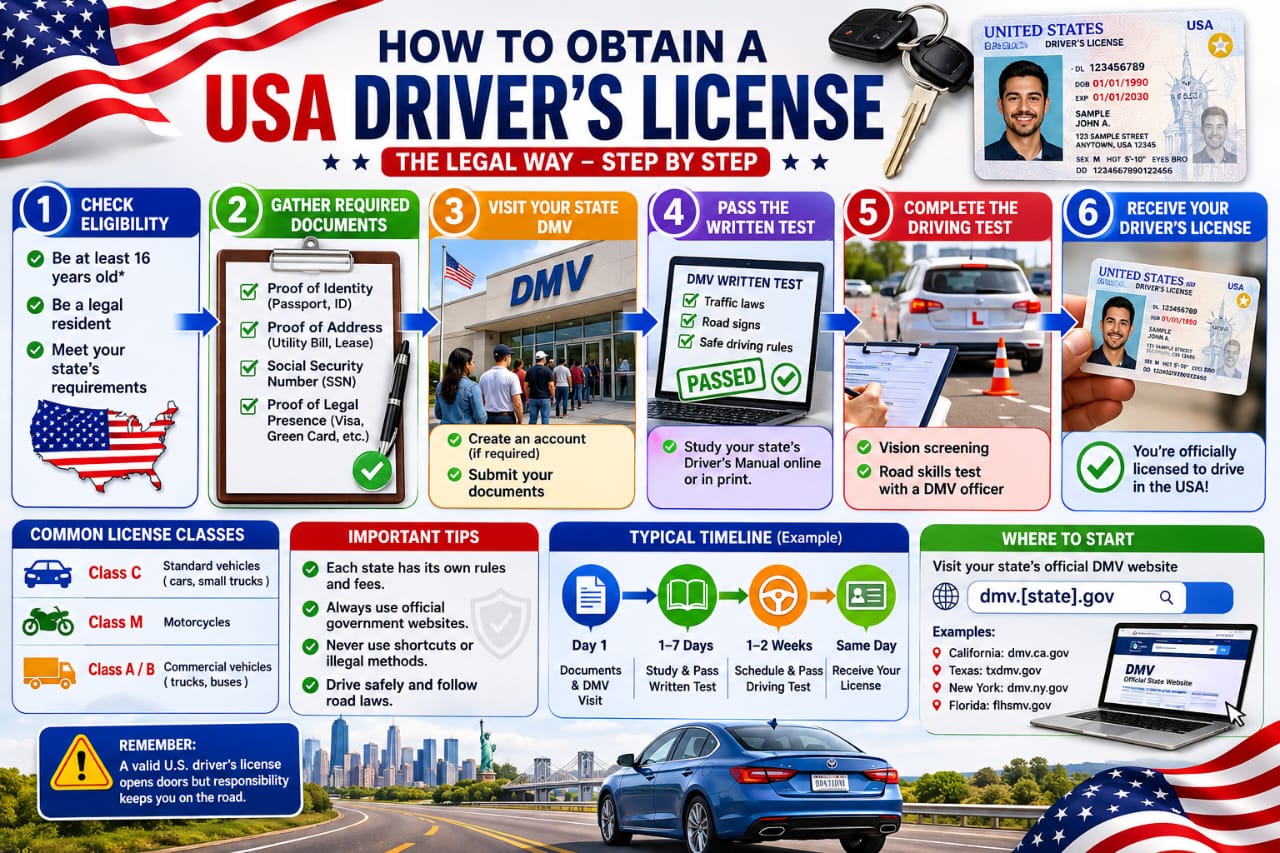
The exact process depends on the state, but most applicants can expect several common steps.
Step 1: Choose the State Where You Will Apply
Your driver’s license is normally obtained through the licensing authority of the state where you live or establish residency.
For example, applicants may deal with agencies such as:
- Department of Motor Vehicles (DMV)
- Department of Driver Services (DDS)
- Department of Public Safety (DPS)
- Secretary of State
- Motor Vehicle Division (MVD)
The name of the agency varies by state.
You can use the official USAGov state motor vehicle directory to locate your state’s licensing agency.
Step 2: Check Your State’s Eligibility Requirements
Before submitting an application, check the requirements for your particular state.
Requirements may depend on:
- Your age
- Whether you are a first-time driver
- Whether you already hold a driver’s license
- Whether you are moving from another U.S. state
- Your immigration or lawful-status documentation
- State residency
- Driving experience
- Whether you need a standard license or REAL ID
- Whether you need a commercial driver’s license (CDL)
Because requirements differ between states, applicants should always verify the current rules with the relevant state licensing agency.
Documents Commonly Required for a U.S. Driver’s License
Although requirements vary, many states require documents proving identity and other eligibility information.
Proof of Identity
Examples may include:
- U.S. passport
- Certified U.S. birth certificate
- Permanent Resident Card
- Other documents accepted by the state
The exact documents accepted depend on the state.
Proof of Social Security Number
Depending on the state’s rules, applicants may be asked for documentation such as:
- Social Security card
- W-2
- Pay stub
- Other acceptable Social Security documentation
For REAL ID applications, states generally require proof of identity, Social Security number, and state residency.
Proof of State Residency
Examples can include:
- Lease or rental agreement
- Utility bill
- Bank statement
- Mortgage statement
- Other official correspondence
Each state determines which documents it accepts.
Do You Need a Social Security Number to Get a Driver’s License?
This depends on the state and your circumstances.
Some applicants may be required to provide a Social Security number, while states may have alternative procedures for people who are not eligible for one.
If you are not a U.S. citizen, check the requirements of the state where you intend to apply before making an appointment.
Do Foreigners and Immigrants Qualify for a U.S. Driver’s License?
In many circumstances, non-U.S. citizens can apply for a state driver’s license if they meet the state’s eligibility requirements.
Depending on the state and the applicant’s circumstances, documentation may include evidence of lawful status, identity, residency, and other required information.
The rules are not identical across the United States, so applicants should verify the requirements directly with their state’s licensing agency.
Step 3: Complete the Driver’s License Application
After determining that you meet the requirements, complete the application through the appropriate state agency.
Some states offer online pre-application services, while others require applicants to appear at a DMV or other licensing office.
During the application process, you may be required to provide:
- Personal information
- Proof of identity
- Proof of residency
- Social Security information
- Immigration or lawful-status documents, where applicable
- Medical or vision information, where required
Step 4: Take the Vision Test
Many states require applicants to pass a vision screening before receiving a driver’s license.
If you wear glasses or contact lenses, you may be required to use them during the examination.
The specific vision standards and testing procedures are established by the state.
Step 5: Pass the Written or Knowledge Test
First-time applicants commonly need to pass a written or computer-based knowledge test.
The test may cover:
- Traffic signs
- Speed limits
- Right-of-way rules
- Safe driving practices
- Parking regulations
- Alcohol and drug laws
- Defensive driving
- State-specific traffic laws
The best way to prepare is to study the official driver’s handbook published by your state’s licensing authority.
Step 6: Obtain a Learner’s Permit if Required
Some new drivers must first obtain a learner’s permit before they can take the road test.
A learner’s permit can allow a new driver to practice driving under specified conditions.
Permit requirements may include:
- Minimum age requirements
- Knowledge test
- Vision test
- Parent or guardian consent for minors
- Supervised driving
- Minimum practice hours
The rules vary considerably between states.
Step 7: Complete Driver Training or Practice
Depending on your age and state, you may need to complete a driver’s education course or a specified amount of supervised driving.
New drivers should use the state’s official requirements to determine:
- Required training hours
- Supervised driving requirements
- Required documentation
- Minimum holding period for a learner’s permit
Step 8: Pass the Road Test
Applicants who are required to take a driving test must demonstrate that they can safely operate a vehicle.
The examiner may evaluate:
- Starting and stopping
- Turning
- Lane changes
- Intersections
- Signaling
- Parking
- Backing
- Observation
- Vehicle control
- Compliance with traffic laws
You should use a properly registered and insured vehicle that meets your state’s requirements for the road test.
Step 9: Pay the Required Driver’s License Fee
Driver’s license fees differ by state and may also depend on the applicant’s age and license type.
Additional fees may apply for:
- Learner permits
- Knowledge tests
- Road tests
- REAL ID
- Commercial licenses
- Replacement licenses
- Expedited services
Always check the current fee schedule with your state’s licensing authority.
Step 10: Receive Your Driver’s License
After completing the required steps and receiving approval, your state will issue your driver’s license.
Some states provide a temporary credential while the permanent card is mailed to the applicant. Others may provide the physical license through a different process.
Follow the instructions provided by your state licensing agency.
How to Get a REAL ID Driver’s License
A REAL ID is a state-issued driver’s license or identification card that meets federal security standards established under the REAL ID Act.
When applying for or renewing a driver’s license, you may have the option to obtain a REAL ID-compliant credential. The documents required are determined by the state.
Common documentation includes proof of:
- Identity
- Social Security number
- State residency
Examples include a U.S. passport or birth certificate for identity, a Social Security card or W-2 for Social Security information, and a lease or utility bill for residency.
A REAL ID is identifiable by a star or similar marking on the credential, depending on the state.
Can You Get a Driver’s License in Any U.S. State?
You cannot simply choose any state and automatically receive a driver’s license there.
You must satisfy the licensing and residency requirements established by the state where you apply. The requirements differ among states and territories.
For example, one state may have different residency-document requirements, testing procedures, or eligibility rules from another.
Therefore, the best approach is to first determine where you legally reside and then review that state’s official driver’s license requirements.
Driver’s License Requirements by State
The United States has different driver’s license systems administered by individual states and territories.
USAGov provides links to motor vehicle services for states and territories including:
- Alabama
- Alaska
- Arizona
- Arkansas
- California
- Colorado
- Connecticut
- Delaware
- Florida
- Georgia
- Hawaii
- Idaho
- Illinois
- Indiana
- Iowa
- Kansas
- Kentucky
- Louisiana
- Maine
- Maryland
- Massachusetts
- Michigan
- Minnesota
- Mississippi
- Missouri
- Montana
- Nebraska
- Nevada
- New Hampshire
- New Jersey
- New Mexico
- New York
- North Carolina
- North Dakota
- Ohio
- Oklahoma
- Oregon
- Pennsylvania
- Rhode Island
- South Carolina
- South Dakota
- Tennessee
- Texas
- Utah
- Vermont
- Virginia
- Washington
- West Virginia
- Wisconsin
- Wyoming
The official state-by-state motor vehicle directory is available through USAGov.
Can You Transfer a Driver’s License From Another State?
If you move to another U.S. state, you may be able to transfer your existing driver’s license rather than completing the entire first-time licensing process.
However, the rules differ by state.
You may need to:
- Establish residency in the new state.
- Surrender your previous driver’s license.
- Provide identity and residency documents.
- Complete a vision test.
- Pass additional tests if required.
- Pay the applicable fee.
Check the requirements of your new state before your move or as soon as possible after establishing residency.
What If You Have a Foreign Driver’s License?
A foreign driver’s license does not automatically become a U.S. driver’s license.
Depending on the state and your circumstances, you may be able to drive temporarily using a valid foreign license, potentially together with an International Driving Permit (IDP), but the rules for obtaining a state driver’s license are separate.
If you plan to become a resident, check the licensing requirements of the state where you will live.
Common Mistakes to Avoid When Applying for a U.S. Driver’s License
Using False Documents
Never use counterfeit, altered, or fraudulent documents when applying for a driver’s license.
False information can result in application denial and potentially serious legal consequences.
Applying Without Meeting Residency Requirements
Do not assume that you can obtain a license from a state simply because its requirements appear easier.
Verify that you meet the state’s residency and eligibility requirements.
Using an Unofficial Website
Driver’s license requirements can change. Use the official state motor vehicle agency whenever possible.
USAGov provides a centralized directory of state motor vehicle agencies.
Ignoring REAL ID Requirements
If you want a REAL ID, make sure you bring the required documentation. REAL ID documentation requirements are determined by each state.
How Long Does It Take to Get a U.S. Driver’s License?
Processing times vary by state and by applicant.
The overall process may include:
- Application processing
- Knowledge testing
- Learner permit requirements
- Driver training
- Road-test scheduling
- Document verification
- License production and mailing
For the most accurate timeline, check the official licensing agency in your state.
How Much Does a U.S. Driver’s License Cost?
There is no single nationwide price for a U.S. driver’s license.
Fees are determined by individual states and can vary according to:
- License type
- Applicant age
- Permit requirements
- Testing
- REAL ID
- Renewal or replacement
- Commercial licensing
Always check the current fee schedule before applying.
Frequently Asked Questions About Getting a USA Driver’s License
Can I get a U.S. driver’s license without taking a driving test?
It depends on the state and your circumstances. Some applicants transferring an existing license may have different requirements from first-time applicants.
Can a non-U.S. citizen get a U.S. driver’s license?
Potentially, yes. Eligibility depends on the state and the applicant’s documentation and lawful-status circumstances.
Can I get a driver’s license in a state where I do not live?
Generally, you must satisfy the state’s residency and eligibility requirements. Do not assume you can select a state solely because its licensing process appears easier.
Is a REAL ID the same as a driver’s license?
A REAL ID is a federally compliant version of a state-issued driver’s license or identification card. It is still issued by the state.
Can I drive with an international driver’s license?
An International Driving Permit is different from a U.S. state driver’s license. An IDP is generally used together with a valid driver’s license from the issuing country and is intended for driving internationally.
Get Help Understanding the U.S. Driver’s License Process
Obtaining a driver’s license can seem complicated when you are unfamiliar with U.S. state licensing requirements. The most important step is to determine which state you are eligible to apply in and then follow that state’s official process.
For general assistance with understanding documentation and application procedures, contact us:
Email: contact@officialdocssupport.com
WhatsApp: +1(672)2050601
Please remember that driver’s licenses are issued by state authorities, and applicants must meet the applicable legal requirements. No legitimate service can bypass a state’s identity, residency, testing, or eligibility requirements.
Conclusion
Learning how to get a USA driver’s license starts with understanding that there is no single federal driver’s license application. Each state establishes its own requirements and procedures.
In most cases, applicants should determine their eligibility, gather acceptable documents, complete the application, pass required vision and knowledge tests, complete supervised driving or driver education when applicable, pass the road test, and pay the required fees.
If you want a REAL ID-compliant credential, additional documentation may be required. The official USAGov directory is a useful starting point for finding the driver’s licensing agency for your state.