
Blog
How to Get an EU Driving Licence Legally

How to Get an EU Driving Licence. Getting a driving licence in the European Union can open the door to greater mobility for work, study, business and everyday life. However, there is no single central authority that issues one universal “EU driving licence.” Instead, driving licences are issued by individual EU member states under EU-wide rules.
If you are wondering how to get an EU driving licence, the legal process normally involves establishing your usual residence in an EU country, meeting the required age and medical conditions, completing the required driving education and passing the relevant examinations.
This guide explains the process in simple terms and shows what you should know before starting your application.
CONTACT US TO FOR MORE INFORMATION
Email: contact@officaldocssupport.com
WhatsApp: +1 (672) 2050601
What Is an EU Driving Licence?
An EU driving licence is a national driving licence issued by an EU member state that follows the common European driving-licence framework.
For example, a licence issued by Germany, France, Spain, Italy, Poland or another EU member state can be recognised across the EU, subject to the applicable rules.
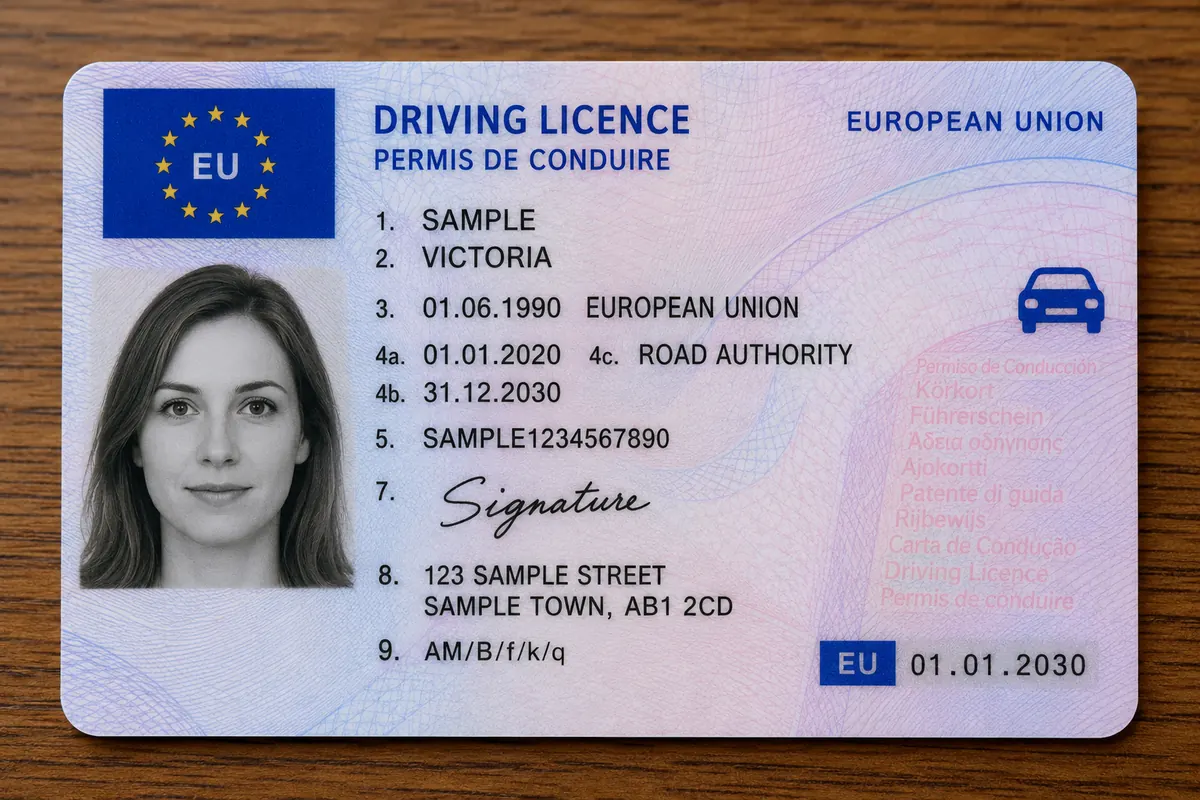
EU driving licences use a standardised format and are designed to make it easier for licensed drivers to drive when travelling or living in other EU countries.
Can Anyone Apply for an EU Driving Licence?
No. You cannot simply choose any EU country and apply for a licence there because you prefer its licensing system.
As a general rule, you should apply in the EU country where you have your normal or usual residence. EU guidance generally defines this as the country where you live for at least 185 days per year because of personal or occupational ties.
This residence requirement is one of the most important parts of the application process.
Step 1: Determine Your Normal Residence
Before applying, determine which EU country qualifies as your normal residence.
For most people, this is the country where they live for at least 185 days in a calendar year.
Your personal circumstances can also matter. For example, if you have personal and professional connections with different EU countries, special rules can apply when determining your normal residence.
If you are studying at a university in another EU country, there are also specific rules. EU guidance states that students may be able to apply in their host country if they can demonstrate that they have been studying there for at least six months.
Step 2: Choose the Driving Licence Category
Before beginning your training, decide what type of vehicle you want to drive.
The most common category for ordinary motorists is Category B, which covers passenger cars.
Other categories are available for motorcycles, larger vehicles, buses and vehicles with trailers. The requirements, minimum ages and examinations can vary depending on the category and country.
For a standard personal vehicle, most applicants will normally be looking at the requirements for Category B.
Step 3: Check the Minimum Age Requirement
Every EU country has minimum age requirements for different driving categories.
The applicable age can depend on:
- The vehicle category
- The country where you apply
- Whether you are a learner or fully licensed driver
- National rules concerning young drivers
Before booking lessons or examinations, check the requirements of the specific national authority responsible for driving licences in your country of residence.
Step 4: Meet the Medical Requirements
Applicants must meet the applicable medical requirements before receiving a driving licence.
Depending on the country and licence category, this may involve an eyesight examination, medical declaration or other health-related assessment.
The requirements can be stricter for professional driving categories than for ordinary passenger-car licences.
The EU’s official guidance confirms that meeting the minimum medical requirements is one of the basic conditions for obtaining a driving licence.
Step 5: Prepare Your Documents
The exact documents depend on the country where you apply, but applicants may be asked to provide documents such as:
- Proof of identity
- Proof of normal residence
- Passport-style photographs
- Medical or eyesight documentation
- Application forms
- Proof of completion of required training
- Examination documentation
- Other documents required by the national licensing authority
Do not assume that the requirements are identical throughout the EU. Each member state administers its own licensing process.
Step 6: Enrol in an Approved Driving School
For a first driving licence, you will normally need to undertake the required driver education and practical training.
An approved driving school can help you understand:
- Traffic regulations
- Road signs
- Safe driving practices
- Vehicle controls
- Parking
- Manoeuvring
- Urban driving
- Rural and motorway driving
- Defensive driving
The amount of training required can vary between countries.
Step 7: Pass the Theory Test
The theory examination tests your knowledge of road safety and traffic rules.
Depending on the country, questions can cover:
- Road signs
- Right-of-way rules
- Speed limits
- Safe following distances
- Overtaking
- Parking
- Hazard awareness
- Driver responsibilities
- Alcohol and drug-related driving rules
- Basic vehicle safety
Passing the theory examination is generally an important stage before progressing to the practical driving examination.
Step 8: Pass the Practical Driving Test
After completing the required training, you will need to demonstrate that you can drive safely and competently.
The practical test may assess areas such as:
- Starting and stopping
- Steering and vehicle control
- Changing lanes
- Turning
- Intersections
- Parking
- Reversing
- Observation
- Speed control
- Interaction with other road users
- Safe decision-making
The precise test format depends on the EU country where you apply.
Step 9: Submit Your Application
Once you have completed the required requirements and examinations, your application can be processed by the relevant national authority.
The authority will verify your documents and eligibility before issuing the driving licence.
Remember that the licence is issued by the national authority, not by a central EU driving-licence office.
Can You Get an EU Driving Licence Without Living in the EU?
Generally, you cannot simply travel to an EU country for a short visit and obtain a first driving licence there.
The normal-residence requirement is designed to prevent people from choosing a country solely because they believe it has easier licensing requirements.
As a general rule, applicants need to apply in the EU country where they normally live, generally for at least 185 days per year.
What If You Already Have a Driving Licence From Another Country?
If you already hold a driving licence issued outside the EU, the process may be different from applying for your first licence.
Some countries may allow certain foreign licences to be exchanged, while others may require additional tests or may not permit a direct exchange.
The rules depend on:
- The country that issued your existing licence
- Your country of residence
- The type of licence
- When the licence was issued
- Whether the issuing country has a relevant agreement with the EU member state
You should therefore check the rules of the specific EU country where you are resident.
Can You Use an EU Driving Licence in Other EU Countries?
One of the major advantages of a valid EU driving licence is that it is generally recognised throughout the EU.
If you move to another EU country, you do not normally have to exchange your licence immediately simply because you moved. However, specific rules can apply to renewal, replacement and certain licence categories.
You can also generally hold only one EU driving licence at a time.
How Long Does It Take to Get an EU Driving Licence?
There is no single EU-wide processing time.
The total time can depend on:
- Your country of residence
- Availability of driving lessons
- Your preparation
- Theory-test availability
- Practical-test availability
- Whether you pass the examinations on your first attempt
- Administrative processing times
For this reason, it is best to begin the process early if you need a driving licence for work, study or relocation.
How Much Does an EU Driving Licence Cost?
There is also no single EU-wide price.
Your total cost can include:
- Driving-school registration
- Driving lessons
- Theory examination
- Practical examination
- Medical examination
- Photographs
- Administrative fees
- Licence issuance fees
Prices can differ considerably between EU countries and even between individual driving schools.
Avoid Fake EU Driving Licence Offers
Be extremely careful with websites and social-media accounts promising an “EU driving licence without a test,” “guaranteed EU licence,” “EU licence delivered without residence,” or similar offers.
A legitimate driving licence must be issued through the competent authority of the relevant EU member state.
A counterfeit or fraudulently obtained document can lead to serious legal and practical problems, including problems with police checks, insurance, employment and future licence applications.
The safest approach is to follow the official licensing procedure in your country of normal residence.
Professional Assistance With Your Driving Licence Application
Understanding the requirements for an EU driving licence can sometimes be complicated, particularly if you are moving between countries, studying abroad or already hold a foreign driving licence.
Our role is to help applicants understand the legitimate procedure, prepare the necessary documentation and navigate the appropriate administrative process.
We do not issue government driving licences. The final approval and issuance of a driving licence remain the responsibility of the competent government authority.
For assistance with understanding the legal application process, you can contact us:
Email: contact@officaldocssupport.com
WhatsApp: +1 (672) 2050601
Frequently Asked Questions About EU Driving Licences
Is there one EU driving licence for all European countries?
No. Driving licences are issued by individual EU member states. However, EU rules establish a common framework and facilitate recognition between member states.
What is the 185-day rule?
As a general rule, you apply for your driving licence in the EU country where you normally live for at least 185 days per year because of personal or occupational ties.
Can I choose the easiest EU country to get a driving licence?
You generally cannot simply choose a country because its licensing process appears easier. The normal-residence requirement applies.
Do I need to pass a driving test?
Yes. EU guidance lists passing a driving test among the basic requirements for obtaining an EU driving licence.
Can I use my EU driving licence when travelling?
A valid EU driving licence is generally recognised throughout the EU, although specific rules can apply depending on the circumstances.
Can I exchange my foreign driving licence?
Possibly. Exchange rules vary depending on the EU country, the country that issued your original licence and your individual circumstances.
Final Thoughts
Getting an EU driving licence legally is a structured process. The most important first step is determining the EU country where you have your normal residence. From there, you can check the national requirements, complete the required medical checks and driver training, pass the theory and practical examinations, and submit your application to the competent authority.
Rather than looking for shortcuts, use the official legal process. A properly issued driving licence provides the strongest protection when driving, travelling, working or living within Europe.
Need help understanding the legal process?
Email: contact@officaldocssupport.com
WhatsApp: +1 (672) 2050601